Penpot vs. Figma: Which Offers More Security?
Compare Penpot and Figma security features, from compliance certifications and access controls to self-hosting, data residency, and deployment flexibility.
Penpot vs. Figma: An enterprise security comparison
Security may not be the first thing you consider when choosing a design platform. But the increasing concern around how to keep data safe while using shared workflows has enterprises looking at every tool (including design platforms) carefully.
Penpot and Figma both share features that safeguard proprietary design data, but they don’t work exactly the same. Figma’s certifications and cloud controls use a different approach than Penpot’s deployment flexibility and data sovereignty.
Here’s how the two compare side-by-side, including why self-hosting is ideal for maximum flexibility and security.
TL;DR
- Penpot competes on deployment flexibility, with the option to self-host for full data sovereignty and regulatory compliance.
- Figma competes on a mature, audited cloud certification stack (SOC 2 Type 2, ISO 27001, ISO 27018).
- Enterprises with strict data mandates may not want to wait on a vendor’s timeline, so self-hosting offers the flexibility to make security decisions as needed.
- Deploying Penpot with Elestio combines the best of self-hosting with cloud-based convenience.
Why we’re comparing Penpot and Figma on security
Penpot and Figma are two of the top design platforms, and enterprises often compare them when deciding what tools to use with their teams. Security matters because these design tools hold more than logos; they contain sensitive business information, such as unreleased product concepts and customer workflow details.
To determine whether a design platform is secure enough for your organization, you need to look beyond its feature set. Certifications, deployment architecture, data residency, and access management all affect where your data lives, who can access it, and how much control your organization retains over it.
That makes Penpot and Figma useful to compare. Figma uses a closed-source, cloud-only SaaS model built around vendor-managed controls and certifications. Penpot offers open-source software and self-hosting options, giving organizations more flexibility to run the platform within their own infrastructure and security requirements.
Understanding the tradeoffs between those approaches can help your organization choose a design workflow that protects sensitive data while meeting its compliance and data-sovereignty needs from the start.
Certifications comparison table
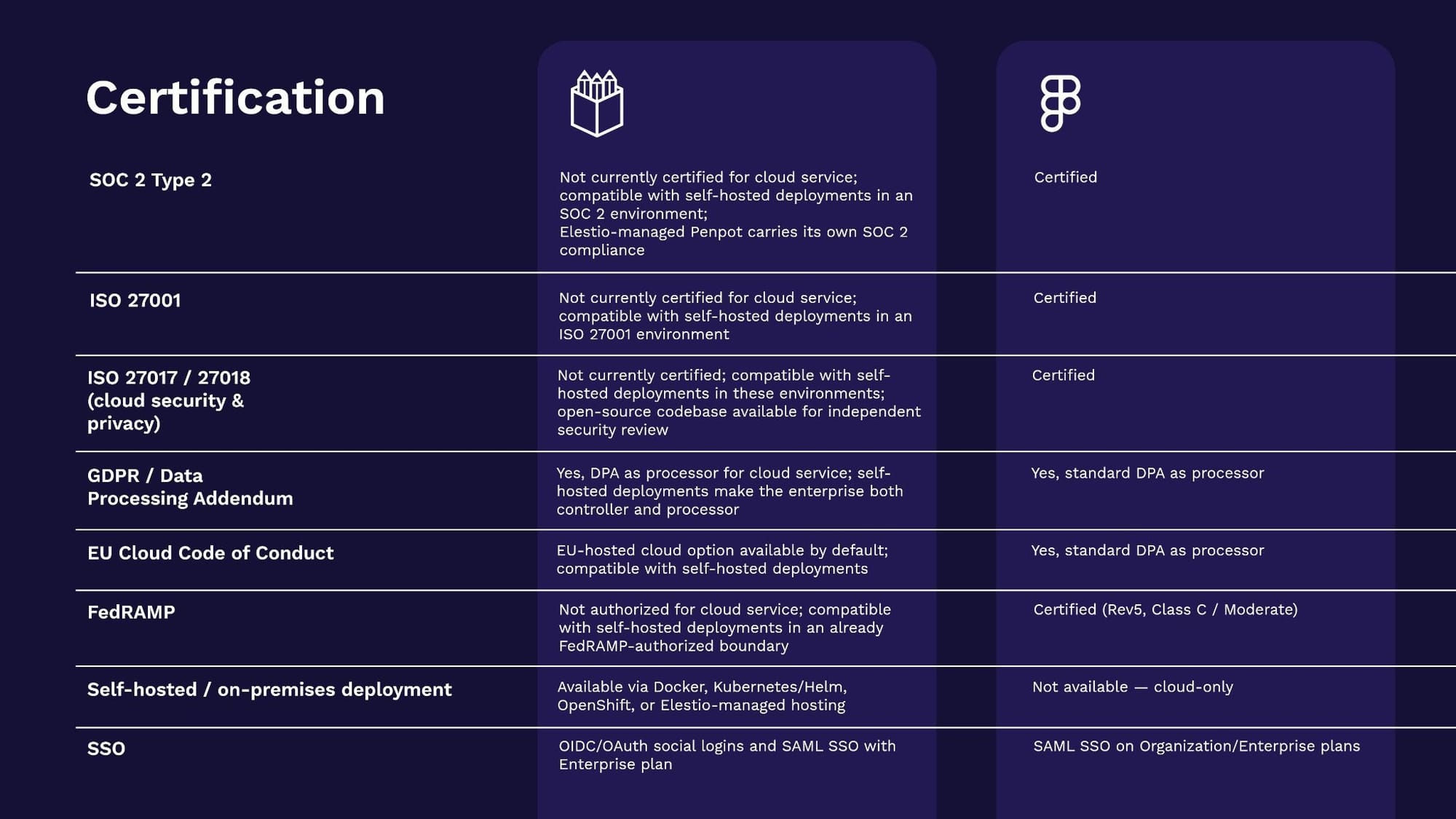
This chart shows Figma and Penpot’s technical specs and how they compare for security certification and control.
Self-hosting and data control
Of all the security traits in a design tool, where the data physically lives and who can access it may be the most important. It’s a major security and governance consideration and determines how truly flexible, transparent, and sovereign your organization can be with its data.
Figma’s cloud-only model
Figma’s approach to data is straightforward. It’s a multi-tenant cloud SaaS product, so you can’t self-host or use an on-premises deployment. All customer files and data live on Figma-managed infrastructure, regardless of an enterprise’s internal policies or the laws and regulations around specific data types.
Figma secures data with a mature security program, using SOC 2 Type 2, ISO 27001/27017/27018, and encryption in transit and at rest. But the shared-infrastructure model requires organizations to trust Figma’s controls instead of enforcing their own. Companies in industries such as healthcare, finance, defense, or government are limited if they want to practice air-gapping or maintain sovereign infrastructure requirements.
Penpot’s self-hosted and open-source options
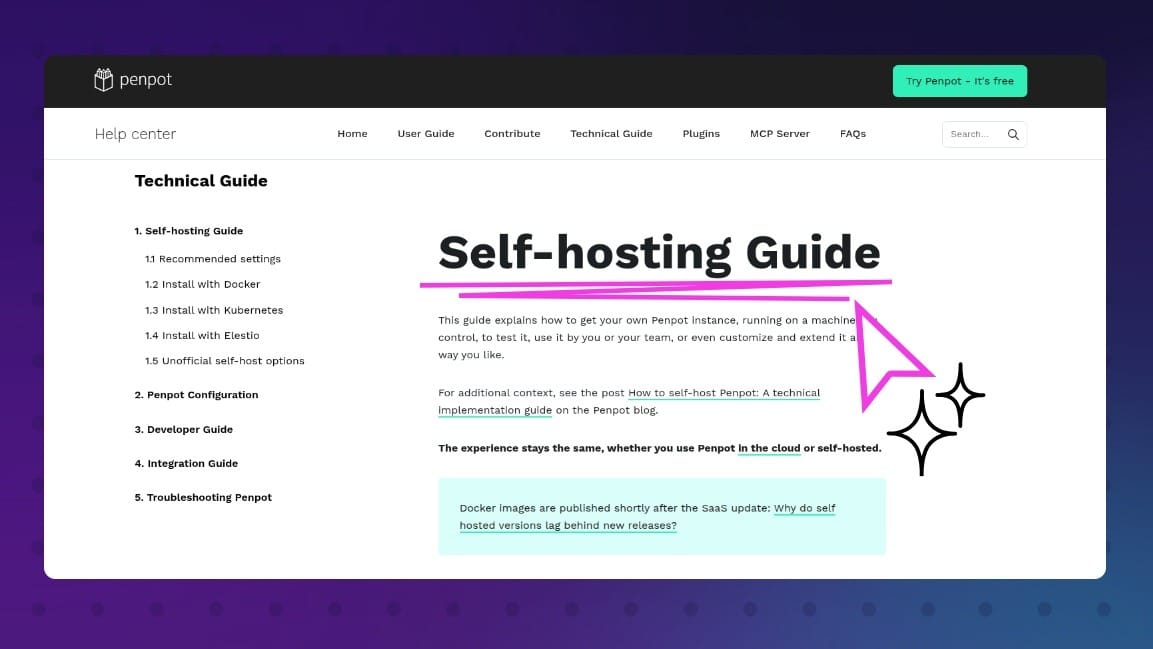
Penpot also offers a cloud-based, SaaS model for ease of setup and maintenance simplicity. It differs from Figma, however, in that it’s just one option. The dual-deployment model gives enterprises the choice to also self-host with deployment through Docker, Kubernetes/Helm, OpenShift, or a managed option through Elestio.
Penpot is also open-source, making it transparent for teams that want to explore or audit the codebase for maximum accountability. Teams can independently verify security implementations instead of relying on a vendor’s security claims.
With the self-hosting option, enterprises can incorporate it into their existing physical infrastructure, isolate the network, and air-gap as needed. It provides flexibility to meet your own compliance bar, whatever you decide that is.
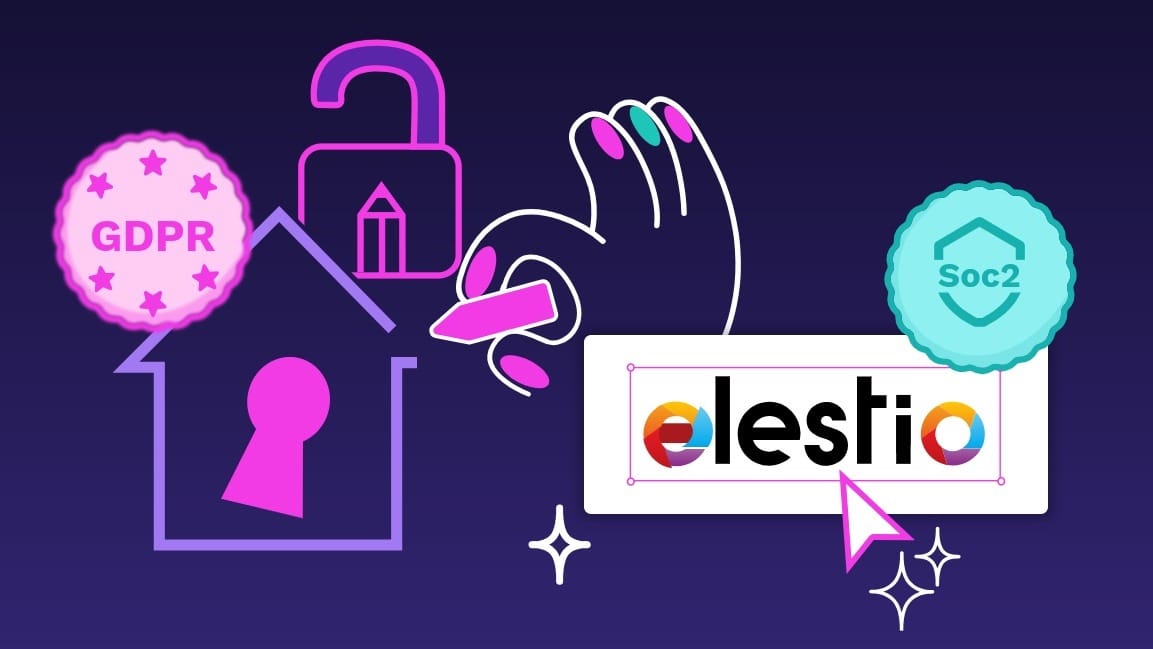
And if self-hosting seems too difficult or expensive, the Elestio solution gives you a fully managed, dedicated Penpot instance to deploy within minutes. Elestio handles the updates, backups, and security monitoring in much the same way a third-party, cloud-based SaaS service would. Offering SOC 2 and GDPR compliance, Elestio offers a middle path between managing a self-hosted Penpot deployment yourself and relying on a cloud SaaS vendor to manage the entire hosting environment. It doesn’t require you to hire your own dev team, either.
GDPR and EU data residency
Enterprise legal and privacy teams need to be certain of where data lives and who controls and processes it at all times. The GDPR and other EU regulations have set the standard for how you process and handle sensitive info. Penpot and Figma have different approaches to how they support compliance with these regulations.
Figma’s GDPR posture and DPA
Because Figma hosts your data in the cloud, it acts as a data processor under a standard Data Processing Addendum (DPA), with the customer as the controller. It currently has high standards for handling that data, including AES-256 and TLS encryption, 30-day deletion post-termination, EU Cloud Code of Conduct level 2 mark, and Standard Contractual Clauses for cross-border transfers.
This is solid but still dependent on Figma to follow through on its promises. Companies get contractual guarantees instead of direct residency control.
Penpot’s EU hosting and self-hosted residency options
Penpot hosts data for its free plan in the EU by default, so it’s already designed with GDPR in mind. Organizations that need US or other regional hosting can get it through the Enterprise plan, either by self-hosting or with a private server option. Penpot also offers a DPA as a processor.
More importantly, Penpot lets organizations self-host, so the enterprise becomes both the controller and the processor. With self-hosting, data can be kept entirely within your chosen environment, enabling true data residency by architecture rather than relying solely on contractual guarantees.
Enterprise access controls (SSO)
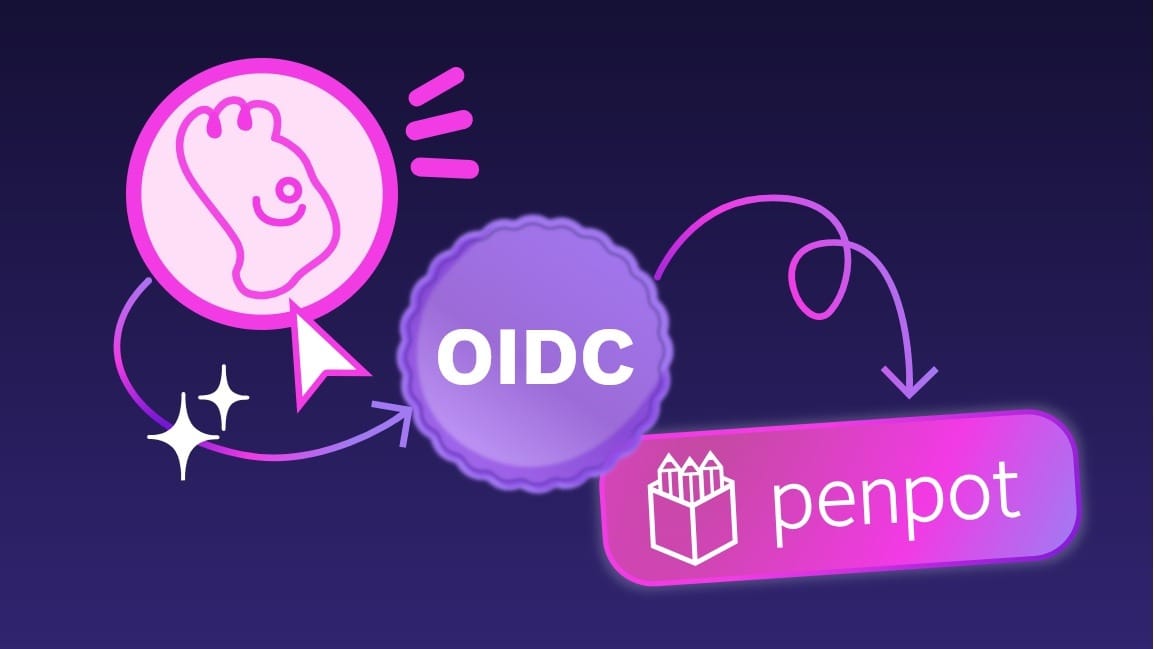
Shared logins and passwords are a common point of weakness, so enterprises look for single sign-on (SSO) as a more secure access control. SSO helps organizations efficiently and securely manage who has access to each software tool and the design files used with them.
Figma supports SAML SSO plus SCIM-based automated provisioning to create, update, and deactivate users securely on its Organization and Enterprise plans. It works with major technologies, such as Okta, Microsoft Entra ID, Google Workspace, and OneLogin.
Penpot supports SSO through OpenID Connect (OIDC), which works with identity providers such as Microsoft Entra ID, Okta, and Keycloak, and self-hosted deployments can also connect through LDAP. SAML isn’t supported natively, but teams can connect through an identity broker such as Keycloak.
Government and FedRAMP
Federal agencies and contractors are limited in what tools they can use; a design tool that hasn't cleared specific authorization requirements may prevent them from accepting secure projects. Federal Risk and Authorization Management Program (FedRAMP) is the standardized way to authorize cloud-based tools. Figma holds a FedRAMP Certification (Rev5, Class C / Moderate) for Figma for Government.
Penpot’s cloud service is not yet certified; however, an agency or contractor can use Penpot’s self-hosted deployment model within their own FedRAMP-authorized infrastructure. Folding it in through an existing System Security Plan and continuous monitoring program can be a compliant way to enjoy Penpot’s design features in ways not possible with cloud-only tools awaiting FedRAMP assessment and approval.
Which design platform is right for your enterprise?
The right platform has less to do with the certification list and more to do with how your organization is required to handle data. Figma and Penpot both have a reputation for being secure, and they frequently update to stay on top of current standards.
Penpot is the better fit for enterprises that need flexibility in how they secure and deploy their design platform. It offers three deployment options:
- Penpot Cloud: Best for teams that want a ready-to-use SaaS platform while relying on Penpot to manage hosting and day-to-day platform operations.
- Self-hosted Penpot: Best for organizations in regulated sectors, such as finance, healthcare, defense, or government, that need to keep design data within their own infrastructure or meet strict data-residency and air-gapping requirements.
- Elestio-managed Penpot: Best for enterprises that need a dedicated Penpot environment and more control over where it runs, but do not want their internal team to manage infrastructure and backups.
Figma may be the simpler choice for enterprises that are comfortable with a cloud-only, vendor-managed platform and its established certification stack, or who enjoy using Figma and don’t have strict data or privacy requirements.
Speak with our team to see if Penpot is right for you
Not sure what the future of your enterprise holds? No matter where you go next, you won’t have to change your compliance requirements to use Penpot. Speak to our team and find out the right deployment option for your infrastructure and data needs.
FAQ
Is Figma SOC 2 compliant?
Yes, Figma holds an SOC 2 Type 2 report covering security, availability, and confidentiality controls. It’s audited annually.
Is Penpot SOC 2 or ISO 27001 compliant?
Kaleidos, the company behind Penpot, doesn’t currently hold SOC 2 or ISO 27001 certification itself. Penpot Cloud is hosted by an EU provider certified to ISO 27001 and ENS High, the highest level of Spain’s National Security Framework. Organizations that need a certified environment can self-host Penpot within their own certified infrastructure or use Elestio to manage it.
Can Penpot be self-hosted for GDPR and data residency reasons?
Yes, self-hosted Penpot allows the deploying organization to be the controller and processor, so data never leaves the chosen environment. This satisfies strict data-residency mandates through architecture instead of software.
Is open-source design software more secure than closed-source?
Open-source software can be independently audited by security teams and the community in ways that closed-source software, like Figma, can’t. It’s not automatically more secure, but it adds a transparency layer that can lead to a more secure environment.
Does Penpot support SSO?
Currently, Penpot’s cloud service supports OIDC/OAuth-based logins, including Google, GitHub, and GitLab, as well as SSO through OpenID Connect, which protects your organization’s teams and files. Teams using the self-hosted option can use any identity provider that supports OpenID Connect or LDAP.
Related blogs
 Paula Tienza
 Andrés González Fernández

 Laura Kalbag