4 reasons why enterprises benefit from open-source design platforms
Whether it’s scaling across hundreds of designers or self-hosting and customizing an instance to meet strict requirements, open-source software gives enterprises the control they need to succeed - and one of the biggest advantages is flexibility.

One of the biggest advantages of open-source design platforms over closed-source tools is flexibility. Whether it’s scaling across hundreds of designers or self-hosting and customizing an instance to meet strict requirements, open-source software gives enterprises the control they need to succeed.
Penpot embodies that promise. As the first open-source design platform built for cross-functional teams, it offers enterprises the freedom to self-host, integrate with existing tech stacks, and design without vendor lock-in.
In the sections ahead, we’ll explore four ways open-source design platforms like Penpot deliver concrete advantages for enterprises: stronger security, greater flexibility, lower costs, and long-term reliability. Improved security and data ownership
1. Improved security and data ownership
Open-source design platforms give you unmatched security and data ownership because you control where your data lives and how it’s protected, and you can verify the code yourself.
This control is especially important for enterprises that handle sensitive data and need to stay in alignment with frameworks like GDPR and HIPAA. The rise of AI has made the value of design data increasingly clear, with major lawsuits emerging against companies like Midjourney and Figma for allegedly using proprietary creative work to train AI models without proper authorization. These cases underscore why enterprises need full control over where their design assets live and how they're used.
By choosing an open-source design platform, you can ensure this part of your tech stack meets the exact security standards your organization requires. For instance, with Penpot, enterprise customers focused on security and data ownership can:
- Self-host Penpot: Keep all files inside your own infrastructure to align with internal security policies and external regulations.
- Rely on open standards: Store assets in widely supported formats like SVG, CSS, and HTML to avoid vendor lock-in.
- Review and customize the code: Audit Penpot’s open-source code for vulnerabilities and adapt it to meet your organization’s compliance and security requirements.
- Get compliance consulting: Enterprise customers can work directly with Penpot experts to review deployments, align with frameworks like GDPR and HIPAA, and ensure design operations meet enterprise standards.
These open-source capabilities give enterprises lasting ownership and the confidence that their most sensitive design assets remain fully under their control.
2. Greater flexibility and customization
Open-source design platforms give you the flexibility to shape tools around your workflows, instead of bending your workflows to fit the tool.
With proprietary platforms, your developers often end up rebuilding layouts by hand, copying CSS snippets, or re-creating components from scratch. All of these processes waste time, introduce errors, and weaken collaboration between design and engineering.
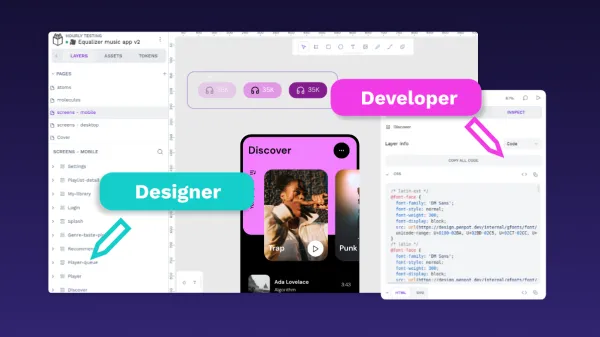
Open source turns that equation around. Because the code is transparent and extensible, enterprises can customize the platform, build integrations, and adapt it to their exact needs. Instead of having to re-create components from scratch, your developers can inspect real CSS, Grid, and Flexbox outputs in Penpot and move them straight into production code.
With Penpot, enterprises can take advantage of:
- Extensibility through APIs and plugins: Enterprises can integrate Penpot into their current stack without vendor restrictions.
- Cross-team collaboration: Open formats like SVG and CSS make it easy for designers and developers to work in parallel without conversion headaches.
- Customization at scale: Self-hosting and open standards let teams configure the platform to match their internal policies and workflows, instead of compromising on a vendor’s defaults.
- MCP servers: Connect AI-powered workflows directly to design files, enabling LLMs to automate design-to-code translation, maintain design systems, and streamline handoffs through our API.
This level of flexibility offered in an open-source platform means enterprises can shape design operations around their strategy rather than reshaping strategy around their tools.
3. Reduced Costs
Design at the enterprise level often means hundreds or even thousands of seats. Proprietary platforms tie those seats to per-user licenses, driving costs up as teams grow and making budgets unpredictable. Add in paid add-ons or feature tiers, and the total cost of ownership can spiral quickly.
Open-source platforms typically eliminate or reduce those barriers. By improving the per-seat licensing and relying on community-driven innovation, they give enterprises predictable, scalable costs without sacrificing capability.
For instance, with Penpot, you get:
- Community-driven innovation: Features evolve through open collaboration, reducing reliance on expensive vendor add-ons.
- Lower total cost of ownership: Between license savings and flexible deployment options, Penpot offers a cost structure built for large teams and long-term planning.
For enterprise leaders, these more flexible pricing factors help your design budgets scale more efficiently as you grow.
4. Increased reliability
Dependability matters. Enterprises can’t risk building design workflows around tools that might lose support, sunset features, or disappear entirely.
Take Adobe XD as an example. Adobe announced the end of support for XD after it was unable to acquire Figma, leaving teams that had invested heavily in XD workflows facing migration challenges and disruption.
Open-source platforms avoid that scenario and offer:
- Long-term sustainability: With open-source licensing, the community helps maintain and evolve the tool, even if the original vendor shifts priorities.
- Self-hosting options: You can run the platform in your own environment - you're not tied to a vendor’s uptime, roadmaps, or business shifts.
- Freedom from lock-in: Because open-source platforms tend to use open formats and allow data export, migration, or extension more easily, there's less risk of being stuck.
For enterprises, reliability means the time, energy, and resources invested in tools are protected from the surprises that often come with proprietary platforms.
Building the enterprise case
Making a business case for design tools is harder than it should be. Unlike engineering platforms or sales software, their value doesn’t always translate into direct revenue numbers. Design improves collaboration, accelerates product delivery, and strengthens customer experience, but those gains are regularly spread across teams and timelines, making them harder to quantify.
Open-source platforms make the business case for a design tool stronger. Predictable costs replace the confusing licensing practices. Compliance and security posture improve with self-hosting. The risk of vendor lock-in disappears. These are concrete advantages that enterprise leaders can measure.
If you’re looking for metrics you can use to make your case, consider tracking these:
- Total cost of ownership (TCO): Track year-over-year savings by comparing Penpot’s self-hosted costs to per-seat subscription fees.
- Compliance audit scores: Measure adherence to GDPR, HIPAA, or SOC 2 through internal audits or third-party assessments.
- Time-to-delivery: Monitor reductions in cycle time from design handoff to development, showing efficiency gains from tighter collaboration.
- Rework percentage: Track how often designs need rework after handoff, and how that rate decreases with open standards and shared code.
The path to adoption can also be incremental. Many enterprises start with a pilot team, validate the savings and efficiency gains, and then expand Penpot across departments. This staged approach lowers risk while proving value along the way.
Get Penpot for your enterprise team today
Open-source design platforms give enterprises the control, flexibility, and reliability that proprietary tools can’t match. Penpot brings those advantages together in a platform built for cross-functional teams, with options to self-host and integrate seamlessly into your existing stack.
If your organization is ready to reduce licensing costs, strengthen compliance, and scale design operations with confidence, Penpot can help. Start by getting in touch with our team so we can discuss self-hosting options tailored to your enterprise needs.
Penpot Enterprise FAQs
Is there enterprise-level support available for Penpot?
Yes. Penpot has an enterprise account that offers advanced security, compliance, private cloud deployment options, and dedicated support.
What integrations does Penpot support?
Penpot includes an open API and plugin system, so enterprises can connect it with their existing workflows. Teams commonly integrate Penpot with Git repositories, CI/CD pipelines, and project management tools. Because Penpot uses open standards like SVG, CSS, and HTML, assets can also flow cleanly into developer environments without relying on proprietary connectors.
How does Penpot support compliance and data governance?
Penpot can be self-hosted, which allows enterprises to keep all design files within their own infrastructure. This makes it easier to meet requirements under frameworks like GDPR or HIPAA, since organizations control where data lives and who has access to it.
Security teams can also audit the open-source code and customize it to align with internal compliance policies, ensuring full visibility and governance over the platform.